



A laboratory team spends years validating a breakthrough in battery chemistry, semiconductor materials, or industrial robotics, secures domestic patents, and wins early commercial backing at home. Yet when that same company tries to sell in Asia, technical superiority alone rarely moves an enterprise buyer from an introductory meeting to a signed commercial contract. Even 30 to 45 days inside a structured Localisation Sprint is often enough to reveal why so many university spin-offs stall after their first international trade mission.
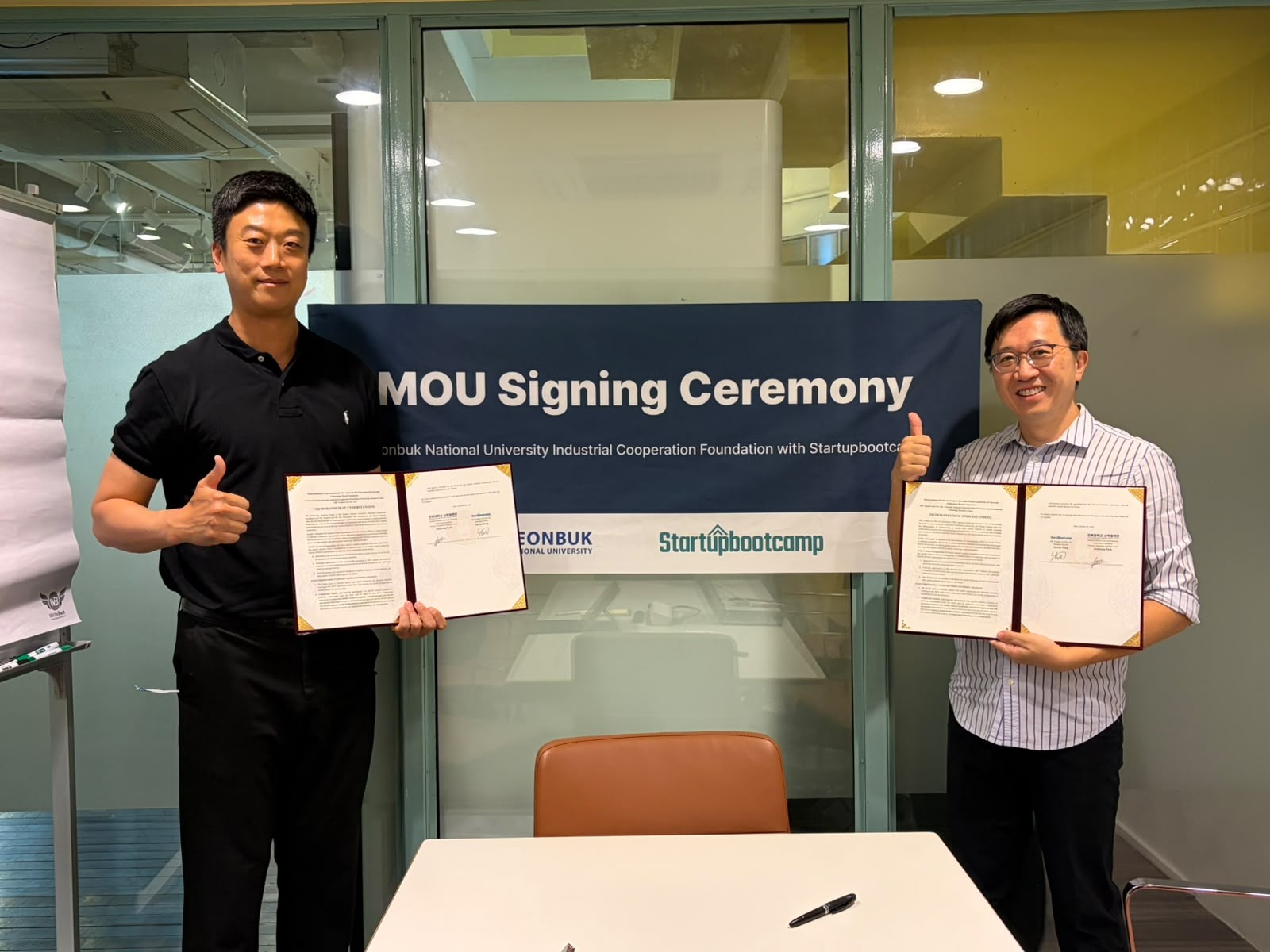
To close the gap between academic research and cross-border revenue, Startupbootcamp Expand (SBC Expand) and the Technology Business Center (TBC) at Jeonbuk National University (JBNU) have signed a Memorandum of Understanding (MOU). The partnership establishes a practical operating pathway for JBNU's research-backed spin-off startups to validate buyer demand, set up a local corporate footprint, and scale commercially across Singapore, Malaysia, and Taiwan through SBC Expand's Build-Operate-Transfer (BOT) model.
How Jeonbuk National University Incubates and Bridges Deep-Tech Spin-Offs
As a flagship national research university in South Korea, Jeonbuk National University has built a strong pipeline of laboratory-born startups through its Technology Business Center (TBC) and university-industry cooperation programs. Rather than treating academic research as an endpoint that stops at journal publication or patent filing, JBNU's incubation model focuses on commercializing university research and turning high-barrier laboratory intellectual property (IP) into venture-backed companies across strategic deep-tech sectors including Physical AI, secondary batteries, semiconductors, advanced bio, and agri-food technology.
Crucially, JBNU does not leave those technologies inside campus laboratories. Through its full-cycle Technology Commercialization Support Platform and its University–Industry–City (JUIC) cooperation framework in Jeonbuk State, JBNU TBC connects academic researchers across its Jeonju main campus and specialized campuses in Saemangeum (Gunsan), Jeongeup, and Iksan directly with industrial testbeds, clinical research centres, and corporate R&D partners across South Korea. By matching laboratory IP with real enterprise demand through tech-matching days, prototype validation studios, and joint commercialization programs, JBNU helps faculty and laboratory spin-offs move from academic prototypes to domestic commercial validation.
Once those companies prove their technology within Korea's domestic industrial corridors, their next growth ceiling is international. For deep-tech sectors such as semiconductor equipment, Physical AI, secondary batteries, and agri-bio systems, the natural expansion markets sit across Southeast Asia and East Asia.
The Structural Challenge: Why University Spin-Offs Struggle Overseas
When a university spin-off with proven laboratory IP looks beyond South Korea, the obstacle is rarely product quality. The obstacle is the commercial structure of cross-border market entry. Academic and deep-tech spin-offs consistently hit three structural hurdles when trying to turn domestic validation into overseas revenue:
1. The upfront cost trap of hiring a local country manager: Hiring a senior country lead in Singapore or Malaysia typically costs USD 150–250K per year in fixed salary before a single local customer contract is signed, and it takes 12 to 18 months to know whether that hire can build a repeatable pipeline. For a research-heavy spin-off that needs to protect its engineering budget, committing that level of unvalidated fixed overhead creates serious financial risk.
2. The limits of remote selling in high-trust enterprise markets: Many technical founders try to avoid fixed overseas headcount by selling remotely from Korea or flying in for short trade expos. While remote outreach looks cheap on a spreadsheet, enterprise and industrial buyers in Asia buy on local presence and trust. When a hospital group in Singapore or a semiconductor plant in Malaysia or Taiwan evaluates a technical vendor, procurement stalls quickly if there is no local entity or on-the-ground operator to stand behind the deployment.
3. Fragmented regional markets that punish one-size-fits-all entry: Across a Southeast Asian digital economy projected to reach USD 1.16 trillion by 2030, each regional hub plays a distinct commercial role. Singapore anchors regional headquarters and regulated enterprise procurement; Malaysia concentrates export manufacturing and semiconductor assembly corridors; and Taiwan leads in global foundry and hardware ecosystems. Managing entry across these markets from a university lab or domestic office stretches a founding team thin and pulls technical leaders away from core R&D.
Conventional export programs rarely solve this delivery gap. Short-term trade delegations generate market reports and introductory meetings, but once the trip ends, the founder is still left without a local entity, a local sales team, or a signed contract.
How the Build-Operate-Transfer Model Bridges the Execution Gap
The MOU between SBC Expand and JBNU TBC addresses that delivery gap directly through the SBC Expand model: acting as an international operating partner that builds and runs the startup's regional business before handing over a proven operation.
SBC Expand is not a cohort-based accelerator with fixed application windows or demo days; it operates on rolling year-round enrollment using a Build-Operate-Transfer (BOT) structure. Instead of asking a JBNU spin-off to commit permanent capital before buyer demand is verified, the model sequences expansion into three phases: validate, enter, sustain:
1. Localisation Sprint (30 to 45 days): Before scaling fixed overhead, SBC Expand works with the startup on product and pricing adaptation alongside targeted market research. This sprint tests concrete buyer demand across the region, identifies which industrial or enterprise segment converts fastest, and produces a validated entry strategy grounded in direct customer conversations.
2. Local Singapore Entity and the GTM Engine: SBC Expand incorporates a Singapore entity for the startup, staffs it with local talent, and runs day-to-day commercial execution across Singapore, Malaysia, and Taiwan. Backed by Startupbootcamp's global track record of 800+ corporate-startup pilots, 100+ corporate relationships, 5,000+ experts, and 1,600+ startups supported since 2010 across 13 offices on 4 continents, the local team generates pipeline, connects founders with corporate partners, and closes initial deals.
3. Compliance, Sales Ops, and Pre-Agreed Buy-Back: Alongside commercial execution, SBC Expand manages regulatory protection, brand positioning, and access to local grants and incentives that a foreign-registered company cannot reach on its own. Through a risk-shared co-investment structure, SBC Expand takes on the operational work of building the initial local presence.
Founders retain full long-term control of their regional business. When the entity is proven and generating revenue, the founder acquires the Singapore entity at a price agreed on day one, and it becomes their permanent Asia headquarters. And if the market says no during validation, the startup walks away cleanly—with no foreign entity to unwind, no severance liabilities, and no office lease. Under this operating structure, one founder closed their first Southeast Asia enterprise deal in 90 days at under 10% of the cost of hiring, representing a 90% cost reduction compared to building a local team from scratch.
Connecting JBNU Lab IP With Corporate Buyers Across the Region
By linking JBNU's Technology Business Center with SBC Expand's regional operating team, the MOU creates a direct commercial bridge from Korean university laboratories to corporate buyers across Singapore, Malaysia, and Taiwan. Spin-offs specializing in semiconductors, Physical AI, and industrial systems can run targeted commercial pilots with electronics packaging, precision manufacturing, and data-centre operators in Malaysia, Taiwan, and Singapore, while advanced bio and agri-food ventures can validate clinical and commercial distribution partnerships through Singapore's life sciences and food resilience ecosystem.
For JBNU founders, this partnership removes the false choice between staying domestic and risking their runway on an unvalidated overseas subsidiary. Founding teams can keep their core engineering anchored in Jeonbuk while a dedicated operating team on the ground turns their laboratory IP into signed commercial contracts.
What Comes Next
The MOU between Jeonbuk National University TBC and Startupbootcamp Expand reflects a practical shift in how universities approach global commercialization. International expansion is measured not by the number of overseas pitch events attended, but by signed contracts, sustained revenue, and a durable local business.
Over the coming months, SBC Expand and JBNU TBC will work together to assess JBNU spin-offs for regional market fit, launch 30 to 45 day Localisation Sprints for selected ventures, and build commercial pipelines across the region.
If you lead a post-PMF technology company or a university commercialization office looking to turn proven research IP into regional enterprise contracts without the upfront burn of traditional expansion, explore how SBC Expand's operating partner model for founders and our outcome-driven partnerships for universities and public agencies structure market entry in Asia.


